


AI Cold Calling: What It Does Well and Where It Fails
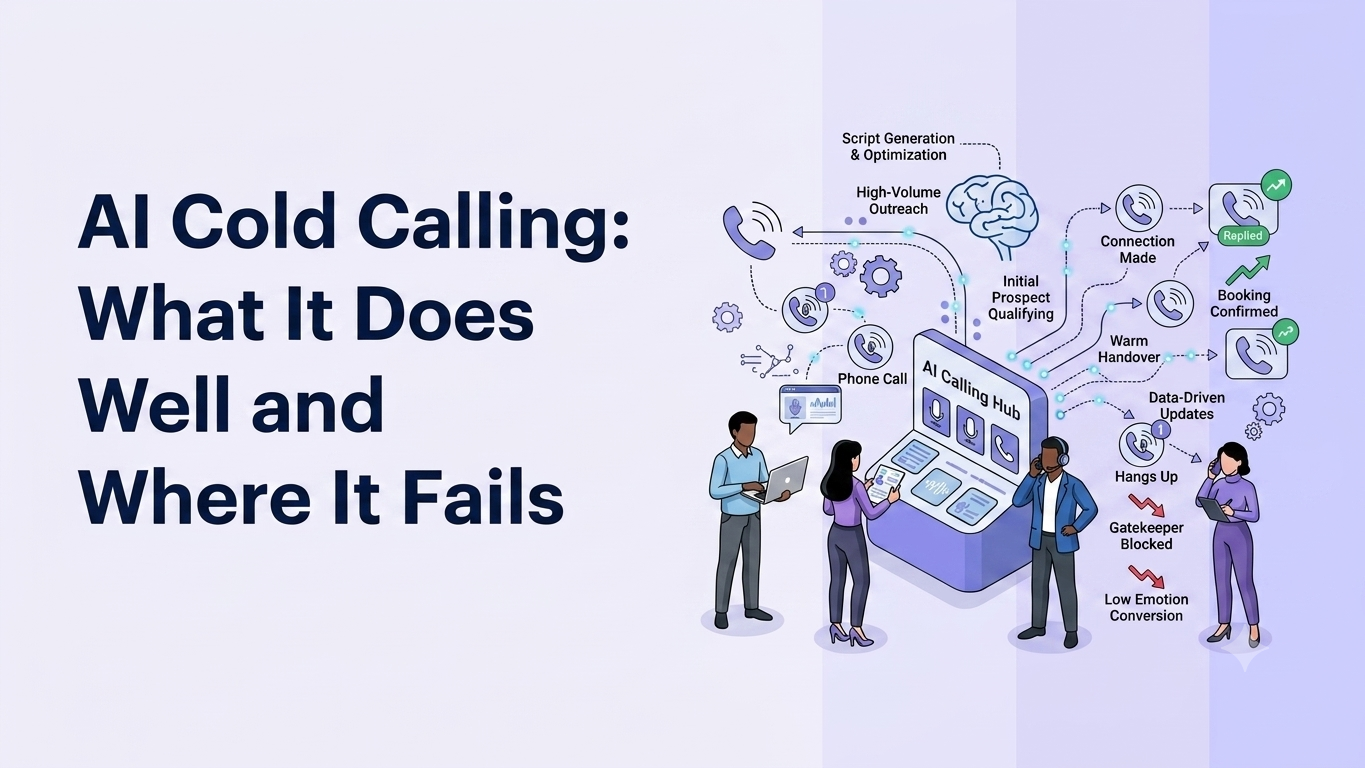
AI cold calling is a qualification and routing layer, not a replacement for your SDRs. It handles the top of the call - dial, disclose, ask three questions, route or book - and falls apart the moment a prospect goes off-script.
Most of what gets written about AI cold calling is sold by people who make money when you believe it replaces headcount. It does not. What it does replace is the twenty minutes an SDR spends dialling numbers that never pick up, and the eight minutes they spend asking questions whose answers were always going to disqualify the account. That is a real problem worth solving, and the tooling in 2026 solves it reasonably well.
How AI Cold Calling Works on a Live Call
This post covers how the technology actually works on a live call, the specific places it breaks, how to design the handoff to a human, and what to look at when you pick a stack.
A voice agent dials, listens, decides, and speaks - and the time it takes to do that decides whether the call survives.
The older architecture chains three models together. Speech-to-text turns the prospect's audio into a transcript, a language model reads the transcript and writes a reply, text-to-speech turns that reply back into audio. Each hop costs time. Stack them and you get somewhere between 1.2 and 2 seconds of dead air after the prospect stops talking.
On a warm inbound call, nobody minds. On outbound, a cold prospect who has already decided this is probably a robot hears that pause and confirms it. They hang up.
Speech-to-Speech Models Are the Right Default for Outbound
Speech-to-speech models skip the transcription hop. Audio goes in, audio comes out, and the model reasons over the raw signal rather than a flattened transcript. In practice this lands response times around 400-600ms - close enough to human conversational rhythm that the prospect stays on the line long enough to hear your opener.
There is a second benefit that matters more than the latency number. Because the model works on audio rather than text, it hears things the transcript throws away. Hesitation. Irritation. Someone half-listening while typing. A text pipeline reduces "yeah, sure, whatever" to three neutral words. A speech-to-speech model can tell the difference between agreement and dismissal.
The tradeoff is control. Text pipelines let you inspect and edit the transcript at every turn, which makes them easier to debug and easier to constrain. Speech-to-speech is faster and more natural but harder to reason about when it does something odd. For outbound cold calling, where the whole game is keeping someone on the phone for ninety seconds, the speed wins.
Two other mechanics decide call quality:
- Barge-in handling. The agent must stop talking the instant the prospect starts. Agents that talk over people get hung up on and generate complaints.
- Silence detection. Distinguishing a thinking pause from a finished sentence. Get it wrong and the agent either interrupts constantly or leaves awkward gaps.
Where AI Cold Calling Beats a Human SDR
On volume, consistency, and the unglamorous parts of the list nobody wants to work.
- Volume without headcount. A hundred concurrent calls costs you compute, not salaries. Your list size stops being constrained by how many people you employ.
- The opener never degrades. Rep number four on a Thursday afternoon does not deliver the same opener they delivered on Monday morning. An agent does. So does the disclosure that they are speaking to an automated system, which matters legally and which humans forget.
- It works the bottom of the list. Every outbound team has a segment of accounts that technically fit ICP but nobody believes in. Those accounts never get called. An agent has no opinion about them.
- Reactivation at scale. Six months of closed-lost and no-response records can be worked in a week. No SDR is volunteering for that.
- Cost per dial. Fractions of a cent per minute of compute against a fully loaded SDR cost. The economics only make sense if the qualification is accurate, but when it is, the gap is large.
Where AI Cold Calling Fails
Anywhere the call stops being a script and starts being a conversation.
This is the section vendors leave out.
- Improvised objections. "We looked at something like this in 2023 and it was a disaster" needs a rep who can ask what went wrong. An agent either has a canned response or it does not, and the canned response is worse than nothing.
- Gatekeepers and switchboards. Phone trees, receptionists who ask what this is regarding, extensions that need dialling. Agents handle simple IVR navigation and lose the rest.
- Audio conditions. Heavy accents, road noise, a bad mobile line, someone on speakerphone in an open-plan office. Human hearing degrades gracefully in these conditions. Models degrade sharply.
- Pricing and scoping questions. The moment someone asks what this costs for a team of forty across three regions, you need a person. Agents that improvise here create commitments you have to walk back.
- Reputational cost. A bad agent call does more damage than no call. The prospect tells their network, and you have burned an account you cannot re-approach for a year.
The pattern is consistent. AI cold calling holds up on the predictable first ninety seconds and breaks on everything after. Design around that rather than against it.
Qualification Logic and the Human Handoff
Get to a yes or no inside sixty seconds, then get out of the way.
Most agent scripts fail because someone treated them like a discovery call. Ten questions, branching paths, follow-ups on follow-ups. Nobody sits through that from a stranger.
Three or four questions. Hardest disqualifier first. Exit early.
A 60-Second Qualification Flow
- Disclose and ask permission. State it is an automated call, name the company, ask for thirty seconds. Roughly a third hang up here, and that is fine - they were never going to buy.
- Hard disqualifier. The single fact that kills the deal. Team size, current vendor, whether they own the budget line. One question.
- Timing. Are they looking at this now, this quarter, or not at all.
- Route. Transfer, book, or close politely.
Three outcomes, and each needs its own path:
- Warm transfer. Best conversion, hardest to operate. Only works when a rep is available right now. Requires the agent to check availability before offering it, not after.
- Booked callback. The prospect picks a slot, the agent books it live, the invite lands before they hang up.
- Calendar meeting. Same mechanic, longer slot, for prospects who qualified strongly.
The escalation triggers that should pull a human in immediately: any pricing question, stated confusion about who is calling, an objection the agent has heard fewer than fifty times, and any signal of irritation.
On the rep side, the failure mode is predictable. The rep picks up and starts discovery from scratch, and the prospect - who just answered three questions - repeats themselves and disengages. Fix it by pushing a context packet to the rep's screen before the transfer connects: the three answers, the trigger that caused escalation, and the agent's last two lines. Train reps to open with a sentence that references what was already said. It is a small habit that decides whether the transfer converts.
Tool Calls, CRM Hygiene, and Sequence Triggers
Voice agents that can call external services mid-conversation do the admin work your reps have been skipping.
An agent that only talks is a demo. An agent that can hit an API while talking is infrastructure.
What this looks like in practice:
- Live calendar booking. The agent checks real availability during the call and writes the invite before the prospect hangs up. No back-and-forth email, no callback that never happens.
- CRM writes without rep data entry. Call outcome, qualification answers, disposition, and recording link land on the record automatically. Every sales ops person reading this knows what rep-entered CRM data looks like after a month. This removes the problem rather than nagging about it.
- Enrichment mid-call. The agent pulls headcount or funding data while the prospect is answering, and branches on it.
- Sequence triggers. This is where cold calling stops being a standalone channel. A "not now, ask me in Q3" outcome fires a nurture sequence with the right date. A "wrong person, try Sarah" outcome triggers a LinkedIn connection request to Sarah and pauses the account. A qualified-but-no-transfer outcome drops the prospect into a three-touch email sequence that references the call.
That last one is the difference between a dialer and a system. The call outcome becomes a signal your email and LinkedIn motion can act on within minutes, while the conversation is still fresh in the prospect's memory.
Scaling Without Burning Your List
Adding concurrency is trivial. Recovering a burned list is not.
Compute scales in an afternoon. Your phone number reputation and your ICP do not.
- Number rotation and call caps. Carriers flag high-volume numbers, and flagged numbers land in the spam-likely label on the recipient's screen. Rotate numbers, cap per-number daily volume, and monitor your answer rate as an early warning.
- Retry discipline. Two attempts, spaced across different days and time blocks. Anything beyond that annoys people and does not convert.
- Consent and disclosure. Rules differ by jurisdiction and are tightening. Disclose that it is an automated call, honour DNC lists, get recording consent where required, and log all of it. This is not a compliance footnote - it is the thing that gets your outbound programme shut down.
- Test small. Two hundred contacts from a segment you can afford to lose. Read every transcript yourself. Fix the script. Then scale.
Build vs Buy: Choosing an AI Cold Calling Stack
Managed platforms get you calling this week. Self-hosted gets you control over data and cost. Pick based on which constraint actually binds you.
The market splits three ways:
Managed platforms. Retell and Vapi handle telephony, orchestration, and model routing behind an API. You configure a script, connect a number, and you are dialling the same day. Per-minute pricing, opinionated architecture, and your call recordings and transcripts sit on their infrastructure. The right choice when time to first call matters more than anything else.
Frameworks. Pipecat gives you the pipeline primitives and nothing else. You assemble the components, you run the infrastructure, you own the on-call rota. Maximum control, real engineering cost, and it assumes you have people who want to own this.
Self-hosted open source. The middle path - a full platform you deploy on your own infrastructure. Self-hosted AI calling agents like Dograh, keep call audio, transcripts, and CRM writes inside your own environment, which is the deciding factor for anyone in healthcare, financial services, or an EU data residency regime. You also stop paying a per-minute margin on top of model costs, which changes the economics once volume gets serious.
Questions worth answering before you commit:
- Where do call recordings live, and can you delete them on request?
- What does this cost at ten times your current volume?
- Can you swap the underlying speech model when a faster one ships?
- How much of your qualification logic is portable if you leave?
- Who gets paged when calls fail at 9am on a Monday?
The honest version of the build-vs-buy tension: most teams should start managed, learn what their script and handoff actually need, and only move to self-hosted when data control or unit economics force the issue. Building first is how you spend a quarter on infrastructure for a script that turns out not to convert.
Metrics That Tell You If It Worked
Cost per qualified conversation, not cost per dial.
Cost per dial always looks good and tells you nothing. The numbers that matter:
- Connect rate. Health of your list and your numbers. A drop here usually means carrier flagging, not bad data.
- Qualified rate. Share of connects that clear your criteria. Compare against your human baseline - if the agent qualifies at twice the human rate, your logic is too loose and your reps are about to lose faith in it.
- Transfer acceptance. Share of offered transfers a rep actually picks up. Below 70% and your availability logic is broken.
- Meeting show rate. The number that separates agent-booked meetings that convert from ones that were agreed to just to end the call.
- Hangup and complaint rate. Your health check. Hangups clustered in the first fifteen seconds mean the opener sounds synthetic.
Give it thirty days before judging. The first two weeks are script iteration, and steady-state numbers look nothing like week one.
Treat AI cold calling as what it is: a fast, tireless, mildly stupid front end to your outbound motion. It dials, discloses, asks three questions, and routes. Everything past that belongs to a person. Teams that design around that boundary get more qualified conversations for less money. Teams that expect AI cold calling to replace their SDRs get a burned list and a story about how the technology is not ready.

.png)
.svg)